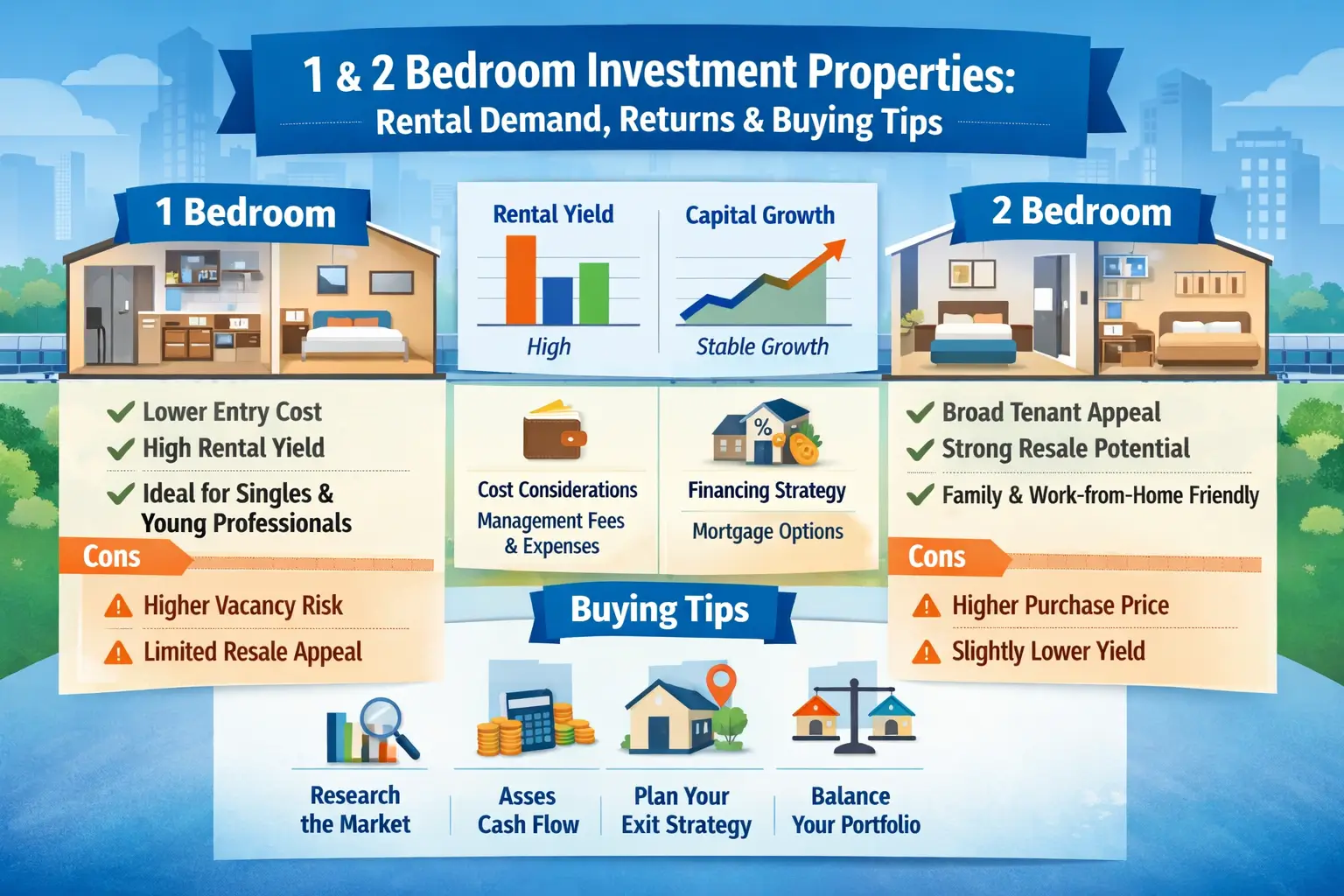
A 1 or 2 bedroom investment property typically delivers the strongest balance of rental demand, affordability, and resale liquidity across most residential markets. These units appeal to the largest tenant pools—singles, couples, young professionals, downsizers, and small households—making them easier to let, simpler to manage, and more resilient during market slowdowns.
What This Guide Covers
This guide examines whether 1 or 2 bedroom properties make sound investment choices, how rental demand behaves across market cycles, what realistic returns look like, and how buyers should approach acquisition decisions. It is written for investors assessing first-time purchases, portfolio diversification, or income-focused residential assets.
The analysis applies broadly across urban and suburban residential markets where apartments, flats, and compact houses dominate rental supply. While pricing, regulations, and taxes vary by location, the demand drivers and risk dynamics discussed here are consistent across mature property markets.
Rental Demand for 1 and 2 Bedroom Properties
Rental demand for 1 and 2 bedroom homes is structurally stronger than for larger units because these properties serve the widest range of tenant profiles. In most markets, they account for the majority of rental transactions each year.
One-bedroom units are typically preferred by single professionals, contract workers, and short- to medium-term renters seeking affordability and location convenience. Two-bedroom units attract couples, roommates, small families, and tenants seeking flexibility for home working or shared living arrangements.
Economic conditions tend to reinforce this demand. During downturns, renters downsize from larger homes, supporting occupancy for smaller units. During growth phases, household formation increases demand for entry- level rentals, again favouring 1 and 2 bedroom stock.
Urban employment centres, transport-connected suburbs, university districts, and healthcare hubs consistently show the highest absorption rates for these property types. Vacancy periods are generally shorter, and tenant turnover, while more frequent than family homes, is predictable and manageable.
Returns Profile: Yield vs Capital Growth
The returns from 1 and 2 bedroom investment properties are typically yield-led rather than growth-led, although well-located assets can achieve both. Rental yields are often higher than larger homes because purchase prices are lower relative to achievable rent.
One-bedroom properties usually deliver the highest gross yields but can show slightly higher volatility in pricing and resale demand in markets dominated by investors. Two-bedroom properties often produce marginally lower yields but demonstrate stronger capital growth and resale appeal to owner-occupiers.
From a risk-adjusted perspective, two-bedroom units tend to offer greater long-term stability. They remain lettable to singles while also appealing to couples and small households, reducing dependency on a single tenant demographic.
Net returns depend heavily on service charges, maintenance costs, local tax treatment, and management expenses. Investors should assess cash flow after all recurring costs rather than relying solely on headline yield figures.
Buying Considerations for 1 vs 2 Bedroom Investments
The choice between a 1 or 2 bedroom investment property should be driven by tenant demand depth, exit flexibility, and long-term resilience rather than purchase price alone. While both categories perform well, their risk profiles differ.
One-bedroom properties are typically easier to acquire at lower capital entry points, making them attractive to first-time investors. However, they are more sensitive to oversupply, particularly in city centres with heavy apartment development pipelines.
Two-bedroom properties provide broader tenant appeal and stronger resale demand because they suit both renters and owner-occupiers. This dual-market liquidity reduces exposure when investor sentiment weakens.
Layout quality matters more than nominal bedroom count. A poorly designed two-bedroom unit with limited living space can underperform a well-proportioned one-bedroom property. Investors should prioritise natural light, storage, privacy between rooms, and flexible use of space.
Costs, Cash Flow, and Financial Viability
Accurate assessment of costs is critical to determining whether a 1 or 2 bedroom property produces sustainable returns. Smaller units often appear more profitable on paper but can carry proportionally higher fixed expenses.
Service charges, strata or management fees, and sinking fund contributions can materially affect net income, particularly in apartment buildings. These costs should be evaluated over multiple years, not just at purchase.
| Cost Category | 1 Bedroom | 2 Bedroom |
|---|---|---|
| Purchase Price | Lower entry point | Higher capital outlay |
| Rental Income | Lower absolute rent | Higher total rent |
| Service Charges | Similar to 2 bed | Similar to 1 bed |
| Void Risk | Moderate | Lower |
Net yield should be calculated after deducting management fees, maintenance, insurance, taxes, and allowance for void periods. Investors focusing solely on gross yield often underestimate true ownership costs.
Financing Strategy and Mortgage Implications
Lenders generally view 1 and 2 bedroom properties as standard residential assets, but underwriting criteria can differ depending on size, location, and building type. Smaller units may face tighter loan-to-value limits in high-density developments.
Two-bedroom properties often qualify for more favourable lending terms due to stronger resale demand and wider buyer appeal. This can translate into better interest rates or higher maximum borrowing levels.
Investors should stress-test cash flow against interest rate increases and rental fluctuations. Conservative financing structures improve holding power during periods of rising rates or temporary vacancies.
Common Investor Mistakes and Risk Factors
A frequent mistake is prioritising yield without assessing market depth. High-yielding one-bedroom units in oversupplied areas may struggle with long-term vacancy and limited capital growth.
Another risk is ignoring future tenant preferences. Remote work trends, lifestyle shifts, and regulatory changes can alter demand dynamics, often favouring flexible two-bedroom layouts.
Investors also underestimate exit strategy importance. Properties that appeal only to investors can suffer pricing pressure during market corrections. Assets attractive to both investors and owner-occupiers retain value more effectively.
Advanced Selection Criteria for Long-Term Performance
Beyond bedroom count, long-term investment performance is driven by micro-location quality, building specification, and functional design. These factors often explain why similar-sized properties in the same city produce very different outcomes.
Transport accessibility, employment density, and proximity to daily amenities are primary demand drivers. Properties within walking distance of rail stations, major bus corridors, hospitals, or universities show consistently higher occupancy and rent stability.
Building fundamentals also matter. Low-maintenance construction, strong sinking funds, and owner-occupier presence within the block reduce long-term costs and support resale values. Investors should review building records, planned capital works, and historical service charge increases before committing.
Internal usability directly affects rentability. Two-bedroom units with a clear separation between living and sleeping zones outperform compact layouts. For one-bedroom units, storage, natural light, and a defined work area materially improve tenant retention.
Portfolio Positioning: When 1 Bed or 2 Bed Makes Sense
The decision to invest in a 1 or 2 bedroom property should align with portfolio objectives rather than isolated yield metrics. Different stages of an investment journey favour different asset characteristics.
One-bedroom properties suit income-focused strategies where capital availability is constrained and rental turnover is acceptable. They can be effective for diversifying across locations or entering high-value markets at lower price points.
Two-bedroom properties are better suited to balanced or growth-oriented portfolios. Their broader demand base supports longer tenancies, smoother resale, and stronger performance through market cycles.
Experienced investors often combine both, using one-bedroom units for cash flow support and two-bedroom units for capital resilience. Portfolio balance reduces exposure to regulatory changes, lending shifts, and demand volatility.
Frequently Asked Questions
Is a 1 or 2 bedroom property better for rental investment?
A two-bedroom property is generally more resilient due to wider tenant and buyer appeal, while a one-bedroom property can offer higher yield in high-demand locations with controlled supply.
Do one-bedroom properties have higher vacancy risk?
They can in oversupplied markets, particularly city centres with heavy new development. In established areas with limited supply, vacancy risk remains low.
Are two-bedroom properties easier to resell?
Yes. Two-bedroom homes attract both investors and owner-occupiers, improving liquidity and price stability during market corrections.
What matters more than bedroom count?
Location quality, layout efficiency, building condition, and long-term demand drivers have a greater impact on performance than bedroom count alone.
Should first-time investors avoid one-bedroom units?
Not necessarily. One-bedroom properties can be suitable if supply is constrained, costs are controlled, and exit strategy is clearly defined.
Key Takeaways
- Demand Depth: 1 and 2 bedroom properties attract the largest tenant pools.
- Risk Balance: Two-bedroom units offer greater long-term resilience and exit flexibility.
- Yield Reality: Net returns depend on total costs, not headline rent figures.
- Design Matters: Layout quality often outweighs bedroom count.
- Portfolio Fit: Asset choice should align with income, growth, and liquidity objectives.
References
- OECD Housing Market Analysis Reports
- Urban Land Institute – Residential Market Trends
- National Rental Affordability Index Publications
- Central Bank Residential Lending Guidelines