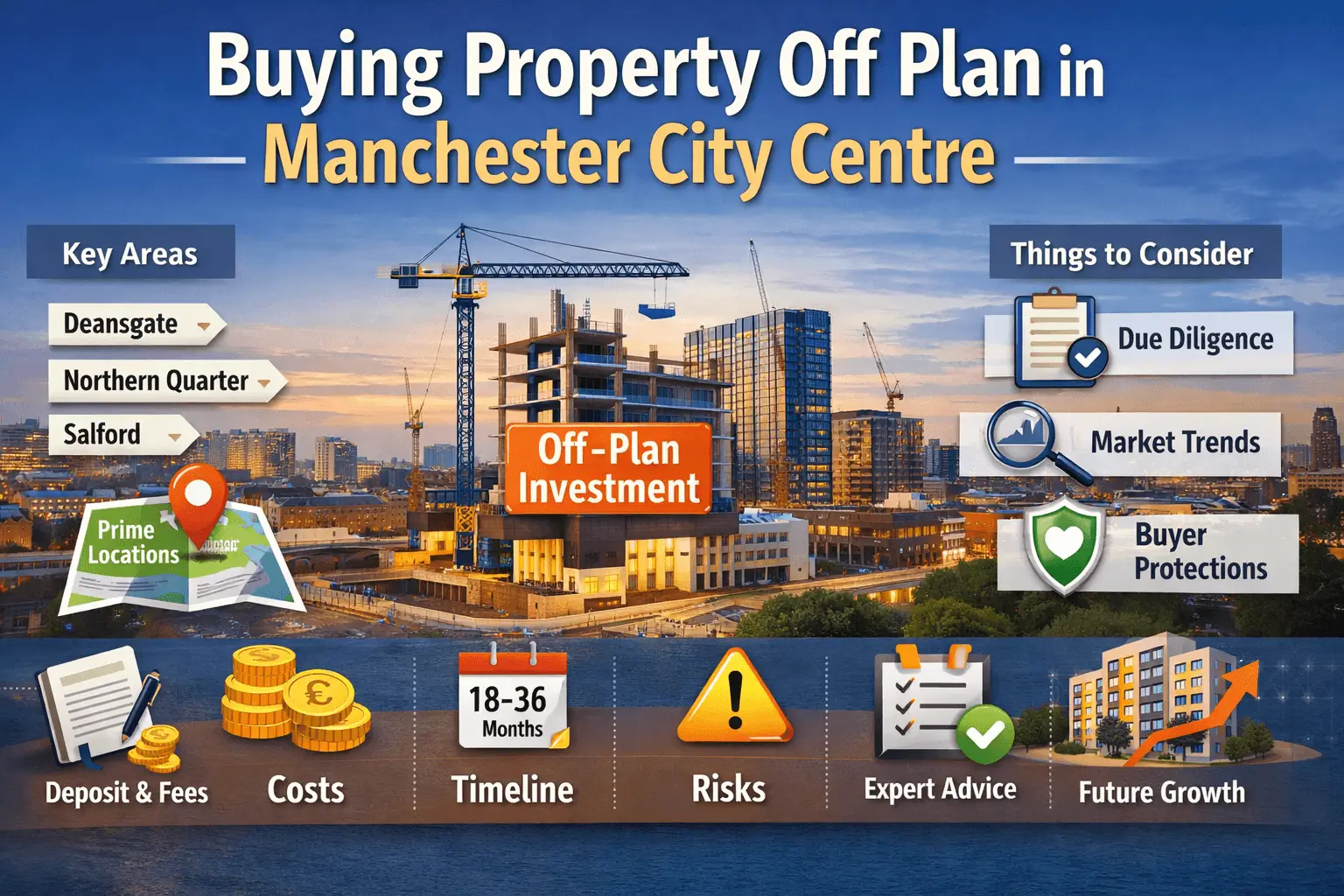
Buying off-plan property in Manchester city centre means committing to a new-build home or investment before construction is complete, typically at an early development stage. For buyers and investors, the core appeal lies in securing a prime location at a fixed price, accessing modern specifications, and benefiting from potential capital growth by completion. The risks are equally real: delivery delays, market shifts, and developer performance. This guide explains where the genuine opportunities are, how off-plan purchases work in practice, and what buyers must assess before committing funds.
What Buying Off Plan in Manchester City Centre Actually Means
Buying off plan in Manchester city centre involves reserving a property before it is built or before construction is finished, based on architectural plans, specifications, and a show apartment or digital renders. Buyers typically pay a reservation fee, followed by a staged deposit, with the balance due on completion once the building is signed off and ready for occupation.
In the Manchester market, off-plan transactions are common in high-density apartment schemes, mixed-use developments, and regeneration-led city centre projects. These purchases are legally binding once contracts are exchanged, even though the property does not yet physically exist.
From a buyer’s perspective, off-plan purchasing shifts part of the risk from construction and market timing onto the purchaser in exchange for early access, choice of units, and potential price advantage. From a developer’s perspective, off-plan sales help fund construction and demonstrate demand to lenders.
Off-plan property in Manchester city centre is most commonly used for:
- Buy-to-let investment targeting professionals, graduates, and corporate tenants
- Owner-occupiers seeking modern apartments close to employment hubs
- Long-term capital growth strategies linked to regeneration zones
Understanding that an off-plan purchase is a forward contract—not a speculative reservation—is essential. Once exchanged, buyers are committed regardless of personal circumstances or short-term market movements.
Why Manchester City Centre Attracts Off-Plan Buyers
Manchester city centre continues to attract off-plan buyers because it combines sustained housing demand, large-scale regeneration, and a constrained supply of new-build land. Unlike suburban expansion markets, city centre growth is driven by employment density, transport connectivity, and lifestyle infrastructure rather than outward sprawl.
The city centre has experienced long-term population growth, underpinned by universities, professional services, technology firms, media, healthcare, and advanced manufacturing. This creates a stable tenant and buyer base for apartments within walking distance of work and amenities.
For off-plan buyers, the city centre offers several structural advantages:
- Consistent rental demand from young professionals and international tenants
- Higher liquidity compared to fringe or unproven locations
- Ongoing public and private investment in transport, public realm, and commercial space
- Planning-led regeneration that improves neighbourhood value over time
Unlike speculative hotspot markets, Manchester city centre is not reliant on a single employer or industry. Its economic diversity reduces downside risk for off-plan buyers holding property through completion and beyond.
However, city centre demand does not remove risk entirely. Pricing must still be benchmarked against comparable completed stock, and buyers must account for future supply pipelines that could affect short-term rental or resale conditions at completion.
Key City Centre Areas for Off-Plan Property Opportunities
Off-plan opportunities in Manchester city centre are not evenly distributed. Performance varies significantly by micro-location, transport access, and regeneration maturity. Buyers should assess each area based on current fundamentals rather than marketing labels.
The most active city centre zones for off-plan development include:
- Deansgate and Castlefield: Established prime locations with strong owner-occupier appeal, limited new land supply, and premium pricing. Off-plan schemes here tend to focus on quality and long-term value rather than entry-level yields.
- Northern Quarter and Ancoats fringe: Popular with younger residents and creative industries. Off-plan pricing reflects lifestyle demand, with solid rental interest but sensitivity to oversupply in smaller unit types.
- Greengate and Salford edge of the centre: Regeneration-led growth areas benefiting from proximity to the core, new infrastructure, and mixed-use masterplans. Off-plan buyers here are often targeting medium-term capital uplift.
- Oxford Road Corridor: Anchored by universities, hospitals, and research institutions. Off-plan developments in this zone are closely tied to academic calendars and professional tenancies.
The most resilient off-plan city centre purchases tend to be those located within established neighbourhoods or clearly funded regeneration zones, rather than isolated schemes relying solely on future promises. Buyers should evaluate walkability, transport links, existing amenities, and competing developments already under construction.
This foundation understanding is essential before assessing pricing, funding structures, legal risks, and return expectations. The next section examines how off-plan pricing in Manchester city centre works in practice, including real costs beyond the headline price.
How Off-Plan Property Pricing Works in Manchester City Centre
Off-plan pricing in Manchester city centre is typically set at the point a development launches, not when construction completes. Prices are based on projected market value, location fundamentals, specification level, and comparable completed schemes, rather than current build status.
Developers price early-release units to secure funding and sales momentum. This can result in lower entry prices compared to later phases, but it does not automatically mean a discount relative to the wider market. Buyers must assess whether the launch price reflects realistic end value rather than assumed future growth.
In city centre schemes, pricing differences are influenced by:
- Floor level, aspect, and views
- Unit size and layout efficiency
- Specification quality and communal facilities
- Proximity to transport, employment hubs, and amenities
- Competing developments completing at a similar time
A well-priced off-plan unit should be defensible against comparable completed apartments in the same micro-location, allowing for new-build premiums without relying solely on speculative appreciation.
True Costs of Buying Off Plan Beyond the Headline Price
The purchase price is only one component of the total cost of buying off-plan property in Manchester city centre. Buyers must budget for staged payments, legal fees, taxes, and ownership costs that arise before and after completion.
| Cost Item | When Paid | What Buyers Should Know |
|---|---|---|
| Reservation Fee | At reservation | Usually deducted from the purchase price but may be non-refundable |
| Exchange Deposit | On contract exchange | Typically 10%–25%, held by solicitor or developer as specified |
| Legal Fees | During conveyancing | Higher than standard purchases due to contract complexity |
| Stamp Duty | On completion | Calculated on purchase price at completion, not reservation |
| Service Charges | After completion | City centre schemes often have higher ongoing costs |
Buyers should also factor in potential cost changes over long build periods, such as mortgage product availability, interest rate movements, and personal financial circumstances.
Step-by-Step Off-Plan Buying Process
The off-plan buying process in Manchester city centre follows a defined legal and financial sequence, with limited flexibility once contracts are exchanged.
- Reservation: Buyer selects a unit and pays a reservation fee to secure it for a fixed period.
- Legal Due Diligence: Solicitors review planning consent, developer obligations, specifications, and completion mechanisms.
- Exchange of Contracts: Buyer pays the exchange deposit and becomes legally committed to the purchase.
- Construction Period: Development progresses; buyers receive periodic updates but have limited control.
- Completion Notice: Developer issues notice once the property is ready for handover.
- Final Payment and Handover: Balance is paid, ownership transfers, and keys are released.
Unlike standard purchases, buyers cannot renegotiate price or withdraw without penalty once exchanged, making pre-exchange due diligence critical.
Financing and Mortgage Considerations for Off-Plan Purchases
Financing an off-plan property in Manchester city centre requires planning well beyond the initial reservation stage. Most buyers exchange contracts without a mortgage offer in place, as completion may be 12–36 months away.
Key financing considerations include:
- Ensuring deposit funds are accessible and not reliant on future borrowing
- Understanding lender criteria for new-build apartments at completion
- Accounting for interest rate changes before mortgage application
- Maintaining credit stability throughout the build period
Some lenders apply stricter loan-to-value limits on new-build city centre flats, particularly for smaller units. Buyers should seek mortgage advice early and reassess affordability closer to completion.
Key Risks of Buying Off Plan and How Buyers Mitigate Them
Off-plan purchases carry specific risks that differ from buying completed property. These risks are manageable but must be acknowledged upfront.
- Construction Delays: Completion dates are estimates, not guarantees.
- Market Changes: Property values and rental demand may shift before completion.
- Specification Variations: Minor changes are often permitted under contract terms.
- Developer Risk: Financial or operational failure can delay or halt delivery.
Experienced buyers mitigate these risks by selecting established developers, avoiding overexposure to a single scheme, stress-testing finances, and ensuring contracts include appropriate long-stop dates and protections.
With pricing mechanics, costs, financing, and risks understood, the final section focuses on buyer decision frameworks, frequently asked questions, and how off-plan purchases fit into long-term property strategies.
Who Should Consider Buying Off Plan in Manchester City Centre
Buying off plan in Manchester city centre is most suitable for buyers who can commit capital early, tolerate development timelines, and make decisions based on fundamentals rather than short-term market noise. It is not a universal solution and should align with a buyer’s financial resilience and objectives.
Buyer profiles that typically align well with off-plan purchases include:
- Long-term investors: Those targeting multi-year holding periods who can absorb short-term volatility and benefit from regeneration-led value growth.
- Buy-to-let landlords: Investors seeking modern, energy-efficient stock that appeals to professional tenants and reduces early maintenance costs.
- Future owner-occupiers: Buyers planning to live in the property upon completion and willing to wait for delivery to secure a preferred location and specification.
Buyers who rely on short-term resale, uncertain financing, or rigid completion timelines are generally less suited to off-plan commitments, particularly in large city centre schemes.
A Practical Decision Framework for Off-Plan Buyers
A structured decision framework helps buyers assess off-plan opportunities objectively and avoid emotionally driven purchases. Each factor should stand on its own merit.
- Location defensibility: Would the property remain desirable if no further regeneration occurred?
- Price benchmarking: How does the off-plan price compare to completed stock nearby?
- Developer track record: Has the developer delivered similar schemes on time and to specification?
- Contract protections: Are long-stop dates, specification clauses, and deposit arrangements clearly defined?
- Exit flexibility: Can the property be rented or refinanced easily if plans change?
If an off-plan unit fails one of these tests, the risk profile increases materially, regardless of marketing narratives or incentives.
Long-Term Outlook for Off-Plan Property in Manchester City Centre
The long-term outlook for Manchester city centre off-plan property is closely tied to employment growth, infrastructure investment, and planning discipline. The city’s role as a regional economic hub supports sustained housing demand, particularly for centrally located apartments.
However, future performance will vary by scheme quality and location. Developments aligned with transport corridors, employment clusters, and mixed-use environments are more likely to retain liquidity and rental appeal over time.
Off-plan property should be viewed as a medium- to long-term strategy rather than a short-term trading asset. Buyers who approach it with disciplined assumptions and realistic timelines tend to achieve more consistent outcomes.
Frequently Asked Questions
Is buying off plan in Manchester city centre risky?
Buying off plan carries higher risk than purchasing completed property due to construction timelines, market changes, and developer performance. These risks can be reduced through due diligence, conservative pricing assumptions, and strong contractual protections.
How long does it usually take for off-plan properties to complete?
Most Manchester city centre off-plan developments complete within 18 to 36 months, although delays are possible. Completion dates are typically estimates rather than fixed guarantees.
Can I get a mortgage for an off-plan property?
Mortgages are usually arranged closer to completion rather than at exchange. Buyers must ensure they remain mortgage-eligible throughout the build period and meet lender criteria for new-build apartments.
Do off-plan properties cost more than existing apartments?
Off-plan properties often carry a new-build premium, reflecting modern standards and warranties. Whether they cost more overall depends on location, specification, and future market conditions at completion.
What happens if the developer fails to complete the project?
Outcomes depend on contract terms and funding structures. Buyer protections may include deposit safeguards and long-stop dates, but recovery can be time-consuming if a project stalls.
Key Takeaways
- Off-plan buying is a forward commitment: Buyers exchange contracts well before completion and must plan finances accordingly.
- Location quality matters more than incentives: Strong micro-locations outperform speculative schemes.
- Total costs extend beyond purchase price: Deposits, legal fees, taxes, and service charges affect real returns.
- Risk is manageable but not removable: Due diligence and conservative assumptions reduce exposure.
- Best suited to patient buyers: Off-plan property aligns with medium- to long-term strategies.
References
- Greater Manchester Combined Authority – Housing and Regeneration Reports
- UK Land Registry – New Build and Apartment Market Data
- Office for National Statistics – Manchester Population and Employment Trends
- UK Finance – Mortgage Lending Criteria for New-Build Properties