Buying property in Hove offers long-term value when the location combines sustained buyer demand, constrained supply, strong transport links, and consistent lifestyle appeal. Areas closest to the seafront, mainline stations, reputable schools, and established retail streets have historically shown greater price resilience and steadier capital growth than peripheral or oversupplied pockets.
Why Hove Is Considered a Long-Term Property Location
Hove is considered a strong long-term property location because it combines coastal scarcity, proximity to London, and a mature residential character that limits overdevelopment. Unlike speculative hotspots driven by short-term regeneration, Hove’s value is underpinned by enduring demand from owner-occupiers, professionals, families, and downsizers.
The town forms part of the Brighton & Hove unitary authority, yet it retains a quieter, more residential identity than central Brighton. This distinction has historically supported price stability during market corrections, as buyers prioritise liveability, school catchments, and transport reliability over nightlife-driven appeal.
From a long-term perspective, Hove benefits from constrained housing stock. Large sections of the town are defined by period buildings, conservation areas, and established streetscapes. This limits large-scale new supply, helping to protect existing property values and reduce volatility.
Hove Property Market Fundamentals
The Hove property market is primarily driven by domestic owner-occupiers rather than speculative investors. This creates a more balanced market where prices are influenced by employment, commuting patterns, and quality-of-life factors rather than short-term yield chasing.
Hove Station and Aldrington Station provide direct rail links to London, Gatwick, and other South East hubs. Consistent commuter demand has supported steady transaction volumes across flats and family houses, particularly within walking distance of stations.
Property types in Hove are dominated by Victorian and Edwardian flats, mansion blocks, and period terraced houses. These properties tend to hold value better over time due to architectural appeal, generous proportions, and limited modern substitutes in equivalent locations.
Key Drivers of Long-Term Value in Hove
Long-term property value in Hove is shaped by a combination of location-specific and structural factors rather than short-term market cycles. Buyers assessing value should focus on fundamentals that remain relevant over decades.
Proximity to the seafront remains one of the strongest value drivers. Seafront and near-seafront properties benefit from permanent scarcity, planning controls, and consistent lifestyle demand. While price entry points are higher, these areas have historically shown greater resilience during downturns.
School catchments also play a critical role. Areas within reach of highly regarded primary and secondary schools attract long-term family buyers, reducing turnover volatility and supporting price stability even when wider market sentiment weakens.
Walkability to independent retail streets such as Church Road and Blatchington Road contributes to long-term desirability. Properties that offer daily convenience without reliance on cars tend to attract broader buyer demographics, supporting liquidity over time.
Understanding these structural drivers is essential before assessing specific neighbourhoods within Hove. Long-term value is rarely accidental; it is the result of consistent demand, restricted supply, and enduring liveability.
Best Areas in Hove for Long-Term Property Value
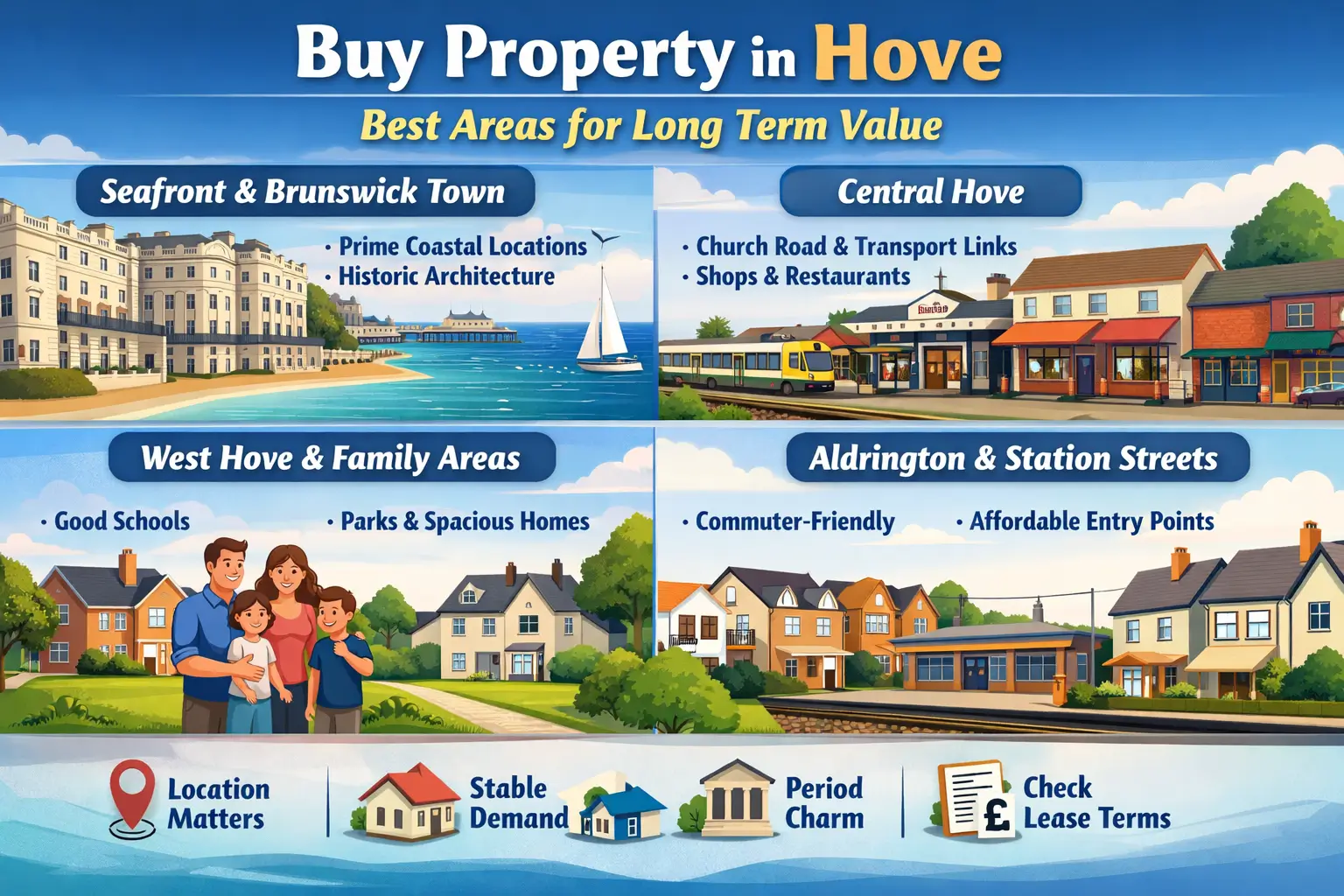
The best areas in Hove for long-term property value are those with established demand, limited redevelopment potential, and proximity to transport, schools, and the seafront. These neighbourhoods attract consistent owner-occupier interest rather than transient demand.
Brunswick Town
Brunswick Town is one of Hove’s most historically resilient areas. Its Grade I–listed squares, proximity to the seafront, and walkability to Brighton city centre underpin long-term value. Properties here are largely period flats with architectural protection, which restricts oversupply and supports capital preservation.
Central Hove (Church Road Corridor)
Central Hove, particularly streets running off Church Road, benefits from retail convenience, transport access, and consistent professional demand. Mansion blocks and larger flats appeal to downsizers and commuters, creating steady resale liquidity across market cycles.
West Hove
West Hove offers a more residential environment with access to green spaces and reputable schools. While price growth is typically steadier rather than rapid, the area attracts long-term family buyers, supporting stable values and lower transaction volatility.
Aldrington and Station-Adjoining Streets
Streets surrounding Aldrington Station provide commuter-driven demand with relatively lower entry prices compared to central Hove. These areas often appeal to first-time buyers and landlords seeking long-term holds rather than short-term appreciation.
Price Performance and Value Retention by Area
Long-term value in Hove is better assessed through price retention and recovery rather than headline growth alone. Historically, prime central and seafront-adjacent areas tend to experience shallower downturns and faster recoveries during broader market corrections.
| Area | Typical Buyer Profile | Value Stability | Liquidity |
|---|---|---|---|
| Brunswick Town | Professionals, downsizers | Very high | High |
| Central Hove | Commuters, owner-occupiers | High | High |
| West Hove | Families | High | Moderate |
| Aldrington | First-time buyers, landlords | Moderate | Moderate |
Areas dominated by owner-occupiers typically show stronger long-term value retention because forced selling is less common during interest rate or employment shocks.
Which Areas Suit Different Buyer Profiles
Matching buyer intent to the right part of Hove is critical for long-term value. Properties perform best when aligned with their natural demand base rather than speculative expectations.
First-time buyers often find better affordability and long-term security in Aldrington or parts of West Hove, where entry prices are lower but fundamentals remain solid.
Investors focused on long-term capital preservation rather than short-term yield typically prioritise Brunswick Town and central Hove, where demand remains deep and consistent even during market slowdowns.
Family buyers usually gravitate towards West Hove due to school access, larger properties, and quieter residential streets, supporting stable resale demand over longer holding periods.
Costs, Risks, and Practical Considerations
Buying property in Hove involves considerations beyond headline purchase price. Period buildings may require higher maintenance costs, service charges, or long-term repair planning, particularly in conservation areas.
Leasehold flats should be assessed carefully for remaining lease length, ground rent terms, and planned major works. These factors can materially affect resale value and long-term returns.
Flood risk is generally low across most of Hove, but seafront-adjacent properties should still be checked individually for insurance and environmental considerations.
Buyers focused on long-term value should prioritise structural quality, location fundamentals, and buyer demand durability over cosmetic upgrades or short-term pricing anomalies.
Long-Term Buying Strategy for Hove
A sound long-term buying strategy in Hove prioritises location fundamentals over short-term pricing opportunities. Buyers seeking durable value should focus on streets and neighbourhoods with consistent owner-occupier demand, limited scope for high-density redevelopment, and enduring lifestyle appeal.
Period properties in established areas often outperform newer stock over longer holding periods because they benefit from architectural scarcity and planning protection. While maintenance costs may be higher, these properties typically retain buyer interest across multiple market cycles.
Timing the market is less critical than buying correctly. Properties purchased in prime or near-prime Hove locations tend to recover value more quickly after downturns, reducing long-term downside risk for buyers with extended holding horizons.
Common Buyer Mistakes in Hove
One of the most common mistakes buyers make in Hove is over-prioritising internal condition at the expense of location. Cosmetic upgrades can be changed, but proximity to transport, schools, and amenities cannot.
Another frequent issue is underestimating leasehold complexity. Short leases, escalating ground rents, or upcoming major works can erode long-term value even in otherwise strong locations.
Buyers also sometimes assume all parts of Hove perform equally. In reality, long-term value varies significantly by micro-location, street quality, and buyer demand profile.
Frequently Asked Questions
Is Hove a good place to buy property for long-term value?
Yes. Hove is widely regarded as a strong long-term property location due to limited housing supply, consistent owner-occupier demand, and reliable transport links to London and the South East.
Which area of Hove holds value best?
Central Hove and Brunswick Town have historically shown the strongest value retention due to proximity to the seafront, transport links, and architectural scarcity.
Are flats or houses better for long-term value in Hove?
Both can perform well, but houses generally offer greater long-term resilience due to land ownership and broader buyer appeal. Well-located period flats with long leases also retain value effectively.
Is West Hove good for family buyers?
Yes. West Hove attracts long-term family demand due to school access, residential character, and larger property sizes, supporting stable long-term values.
What risks should buyers consider in Hove?
Key risks include leasehold complications, higher maintenance costs for period buildings, and overpaying for properties outside established demand areas.
Key Takeaways
- Location drives value: Central, well-connected, and seafront-adjacent areas outperform over time.
- Owner-occupier demand matters: Areas dominated by long-term residents show greater price stability.
- Period stock remains resilient: Architectural scarcity supports long-term value retention.
- Leasehold due diligence is critical: Terms and future costs directly affect resale value.
- Buy for durability, not hype: Long-term value in Hove comes from fundamentals, not short-term trends.
References
- UK Land Registry – Residential Property Price Data
- Brighton & Hove City Council – Planning and Conservation Areas
- Office for National Statistics – Housing Market Analysis
- Network Rail – Southern Rail Connectivity Overview