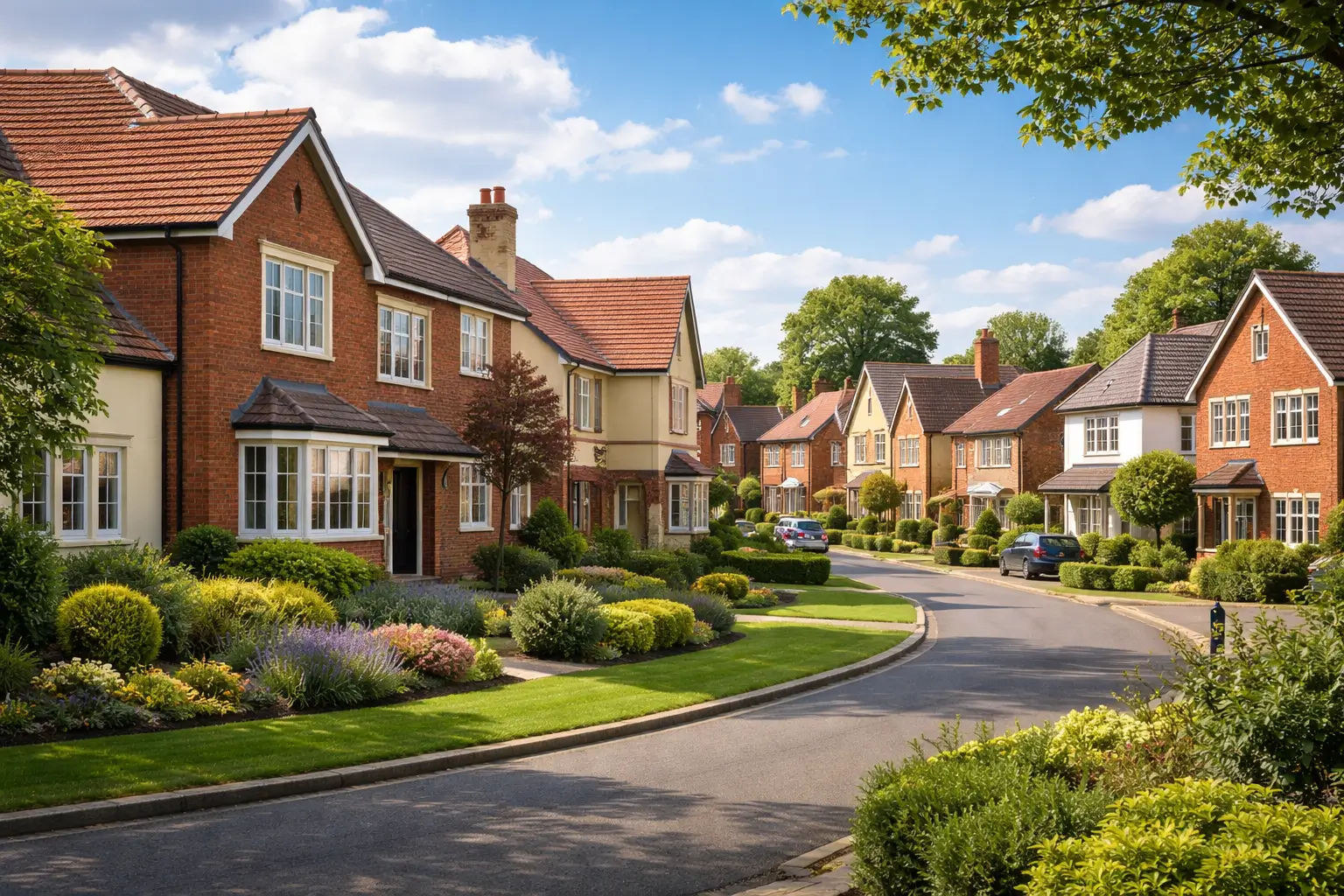
Farnborough is a well-connected Hampshire town where property buyers typically choose between stable long-term value, commuter convenience, and a balanced cost-to-lifestyle ratio. House prices sit below many neighbouring Surrey hotspots, while demand is supported by rail links to London, a strong local employment base, and consistent rental interest. For buyers considering Farnborough, the core questions are price expectations, which areas suit different lifestyles, and how the local market behaves compared with surrounding towns.
Why Buy Property in Farnborough?
Buyers choose Farnborough primarily for its location and predictability rather than short-term price spikes. The town sits in north-east Hampshire, close to the Surrey border, making it attractive to London commuters who want more space without crossing into higher-priced counties. Direct rail services connect Farnborough Main to London Waterloo in under 40 minutes, which anchors demand even during slower market cycles.
Employment stability is another factor supporting the local housing market. Farnborough has a long-standing association with aviation, engineering, and technology, alongside proximity to business hubs such as Farnborough Business Park, Fleet, and Aldershot. This creates a steady flow of professional tenants and owner-occupiers, reducing volatility compared with towns reliant on a single employer.
From a lifestyle perspective, Farnborough appeals to buyers seeking practicality rather than prestige. The town offers established schools, everyday retail, leisure facilities, and easy access to green spaces such as Farnborough Abbey grounds, Queen Elizabeth Park, and nearby countryside toward Yateley and Ewshot. This combination tends to attract families and long-term residents, which in turn supports resale liquidity.
For investors, Farnborough’s appeal lies in consistent rental demand rather than high yields. The presence of professionals, armed forces personnel linked to Aldershot, and relocating families means void periods are typically manageable when properties are priced correctly. While it is not a speculative hotspot, it is often viewed as a lower-risk commuter market within the South East.
Current House Prices in Farnborough
Farnborough house prices generally sit in the mid-range for Hampshire commuter towns. Flats and smaller houses are more affordable than comparable properties in Farnham, Guildford, or parts of Surrey, while larger detached homes still command a premium in established residential pockets. This pricing structure makes Farnborough accessible to first-time buyers while remaining relevant to upscalers.
Entry-level flats, particularly around Farnborough town centre and North Camp, tend to attract first-time buyers and investors. These properties benefit from transport links and amenities but can vary significantly in quality depending on building age, service charges, and lease terms. Buyers should assess long-term costs carefully, as headline prices do not always reflect true ownership expenses.
Family houses form the core of the owner-occupier market. Three-bedroom semis and terraces in established neighbourhoods are consistently in demand, especially where they fall within catchment areas for well-regarded primary schools. Price growth in this segment is typically steady rather than dramatic, reflecting sustained demand rather than scarcity-driven inflation.
Detached homes and modern developments on the outskirts of Farnborough appeal to higher-income buyers seeking space, parking, and newer construction standards. These properties are more sensitive to interest rate changes but benefit from limited supply. As a result, values tend to hold up better over longer periods, even if transaction volumes fluctuate.
Overall, Farnborough’s pricing reflects its role as a functional commuter town rather than a prestige address. Buyers should expect realistic negotiations, particularly on properties requiring modernisation or those with less favourable micro-locations. Well-presented homes near transport and schools, however, often attract competitive interest.
Best Areas to Live in Farnborough
Farnborough is not a uniform market; values and buyer profiles vary noticeably by area. Understanding these micro-markets is essential for matching budget, lifestyle, and long-term plans.
Farnborough Main and Central Farnborough appeal to commuters and apartment buyers. Proximity to the mainline station, shops, and services makes this area practical, but noise levels, parking, and building management quality should be assessed carefully. This location suits buyers prioritising convenience over space.
North Camp offers a mix of Victorian terraces, purpose-built flats, and more affordable housing options. It attracts first-time buyers and investors due to relative value and transport access, including North Camp station. While some streets benefit from character and community feel, others require careful due diligence on condition and future resale appeal.
South Farnborough is popular with families seeking quieter residential streets and access to schools. Properties here tend to command a confirmed premium due to perceived desirability and stability. Buyers often compete for well-maintained houses, particularly those with gardens and off-street parking.
Cherrywood and Cove are established residential areas offering a suburban environment. These locations appeal to buyers looking for space, local amenities, and a longer-term home rather than short-term investment. Demand is typically driven by owner-occupiers, which supports price resilience.
Choosing the right area in Farnborough depends less on postcodes and more on street-level factors, including school catchments, traffic patterns, and proximity to green space. Buyers are advised to visit at different times of day to understand how each area functions in practice.
Who Farnborough Is Best Suited For
Farnborough is best suited to buyers who value predictability, access, and long-term usability over short-term capital surges. The town consistently attracts commuters, families, and professional renters, which shapes both pricing behaviour and resale dynamics.
First-time buyers often find Farnborough accessible compared with neighbouring Surrey towns. Flats and smaller houses provide realistic entry points, particularly for buyers prioritising rail access over large internal space. However, careful scrutiny of lease terms and service charges is essential.
Families typically focus on South Farnborough, Cove, and Cherrywood, where residential layouts, schools, and lower traffic density align with long-term living. These buyers tend to stay longer, which contributes to stable local demand rather than frequent turnover.
Investors and landlords are usually drawn by rental consistency rather than yield maximisation. Farnborough supports steady tenant demand from professionals and military-linked employment nearby, but returns are sensitive to purchase price discipline and property condition.
Upsizers and downsizers often move within Farnborough rather than leaving the area entirely. This internal mobility supports liquidity for well-located houses and bungalows, particularly those offering parking and manageable maintenance.
Buying Process and Timelines in Farnborough
The property buying process in Farnborough follows standard England and Wales conveyancing practice, but local market conditions influence pacing and negotiation dynamics. Most transactions proceed in predictable stages, though chain length can significantly affect timelines.
After an offer is accepted, buyers typically instruct solicitors familiar with Hampshire local authority searches. Turnaround times for searches are generally reasonable, but delays can arise where leasehold management companies are slow to provide documentation.
Surveys play a critical role in Farnborough due to the mix of property ages. Victorian and mid-20th-century homes may reveal issues such as outdated electrics, roofing wear, or historical alterations. Buyers who commission appropriate surveys early are better positioned to renegotiate or plan remedial works.
Mortgage approval timelines depend less on location and more on borrower profile, but lenders may scrutinise flats with high service charges or short leases more closely. New-build and recently converted properties can also attract additional valuation conditions.
In straightforward cases, transactions can complete within eight to twelve weeks. Chains, leasehold complexity, or title irregularities can extend this considerably, so buyers should plan accommodation and finances with flexibility.
Costs and Ongoing Expenses to Consider
Buying property in Farnborough involves more than the purchase price. Buyers should account for acquisition costs, ownership expenses, and future liabilities when assessing affordability.
Upfront costs typically include stamp duty, legal fees, survey costs, mortgage arrangement fees, and moving expenses. These vary by property value and buyer circumstances, but underestimating them is a common source of financial pressure.
Leasehold costs deserve particular attention. Service charges, ground rent, and planned major works can materially affect long-term affordability. Some older blocks in central areas have higher maintenance obligations, which should be factored into budgeting from the outset.
Ongoing ownership costs such as council tax, utilities, insurance, and maintenance differ by property type and area. Houses generally offer greater control over costs than flats, but require proactive maintenance planning.
For landlords, additional considerations include compliance costs, letting fees, and periods without rental income. Farnborough’s rental market rewards well-maintained, sensibly priced properties rather than minimal-investment strategies.
Common Buyer Mistakes in Farnborough
One of the most common mistakes buyers make in Farnborough is assuming uniform value across the town. Micro-location factors such as school catchments, traffic flow, and proximity to commercial areas can materially affect both enjoyment and resale value.
Another frequent issue is underestimating leasehold complexity. Buyers attracted by lower flat prices sometimes overlook service charge trajectories or lease length, only to face refinancing or resale challenges later.
Skipping or minimising surveys is also risky. Older housing stock can conceal costly defects, and reliance on lender valuations alone rarely provides sufficient protection for owner-occupiers.
Finally, some buyers overextend budgets based on optimistic assumptions about future price growth. Farnborough rewards disciplined purchasing aligned with personal needs and long-term holding rather than speculative stretching.
Long-Term Market Outlook for Farnborough
Farnborough’s long-term property outlook is shaped by structural rather than cyclical factors. Transport connectivity, employment diversity, and sustained housing demand from commuters and families underpin market resilience even during broader economic slowdowns.
Unlike speculative hotspots, Farnborough rarely experiences abrupt price surges or sharp corrections. Instead, values tend to move gradually, reflecting real demand rather than investor sentiment. This makes the town particularly suitable for buyers planning to hold property over multiple market cycles.
Ongoing infrastructure maintenance, redevelopment of commercial zones, and continued pressure on housing supply in the wider South East are expected to support demand. However, growth is likely to remain incremental, rewarding patient, needs-led buyers rather than short-term traders.
From an investor perspective, future performance will depend heavily on asset selection. Properties close to rail links, schools, and established residential streets are more likely to retain liquidity and rental appeal than marginal locations or poorly specified developments.
Buying vs Renting in Farnborough
The decision to buy or rent in Farnborough depends largely on time horizon and lifestyle stability. Renting offers flexibility for short-term residents or those uncertain about long-term plans, particularly given the availability of professional rental stock.
Buying becomes more compelling for households intending to remain in the area for several years. Mortgage costs can be comparable to rents over time, while ownership provides insulation from rental market volatility and the ability to adapt the property to personal needs.
For families and long-term commuters, ownership often aligns better with schooling continuity, community ties, and predictable housing costs. Conversely, buyers anticipating frequent relocation may find that transaction costs outweigh ownership benefits.
Importantly, Farnborough’s market does not penalise either choice. Both rental and owner-occupier demand are well established, allowing residents to move between tenure types as circumstances change.
Frequently Asked Questions
Is Farnborough a good place to buy property?
Farnborough is considered a solid choice for buyers seeking commuter access, stable prices, and practical living rather than rapid capital growth.
How long does it take to buy a house in Farnborough?
Most purchases complete within eight to twelve weeks, although chains and leasehold complexities can extend this timeframe.
Are Farnborough house prices rising?
Prices tend to rise gradually over time, reflecting steady demand rather than sharp growth cycles.
Which areas in Farnborough are best for families?
South Farnborough, Cove, and Cherrywood are commonly preferred for their residential character and access to schools.
Is Farnborough suitable for property investors?
Farnborough suits investors focused on consistent rental demand and lower volatility rather than high-yield or speculative strategies.
Key Takeaways
- Market profile: Farnborough offers stable, commuter-driven demand rather than volatile price growth.
- Buyer suitability: Ideal for families, professionals, and long-term holders seeking predictability.
- Area selection: Micro-location matters more than postcode, particularly for schools and transport.
- Ownership outlook: Best suited to buyers with medium- to long-term plans rather than short-term speculation.
References
- HM Land Registry – Price Paid Data
- UK Government Conveyancing Guidance
- Local Authority Housing and Planning Publications