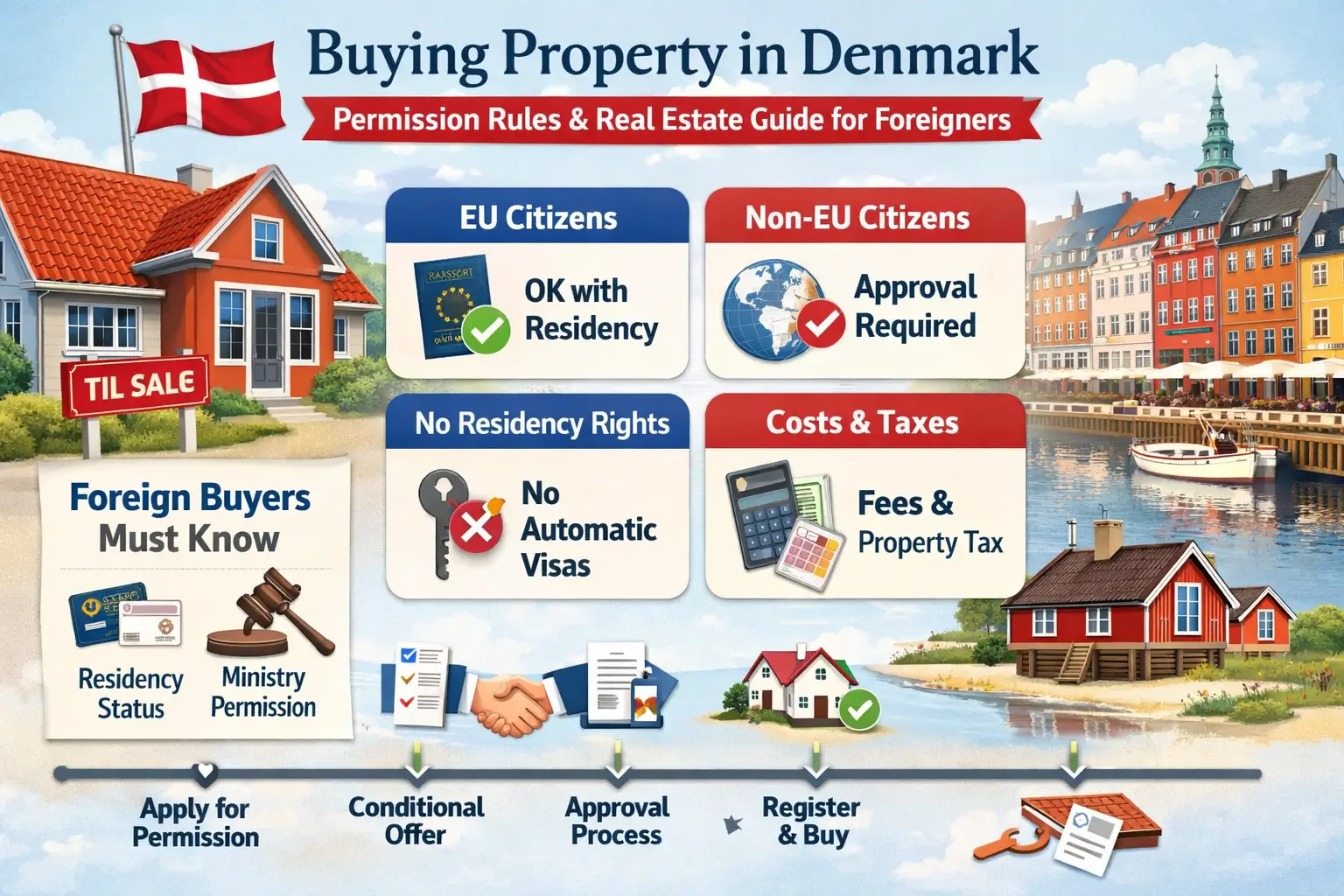
Foreigners can buy property in Denmark, but only under specific legal conditions tied to residency status, EU/EEA nationality, and the intended use of the property. Most non-residents require formal permission from the Danish Ministry of Justice before purchasing real estate, and failure to comply can invalidate a transaction. This guide explains exactly who can buy property in Denmark, what permissions are required, and how the Danish real estate system works in practice.
Can foreigners buy property in Denmark?
Yes, foreigners can buy property in Denmark, but the right to do so is not automatic. Danish law restricts property ownership to prevent speculative buying and to protect national housing availability. Whether a foreign buyer can proceed freely or must obtain special approval depends on residency, citizenship, and how the property will be used.
In practical terms, Denmark divides foreign buyers into three categories: EU/EEA residents with genuine ties to Denmark, EU/EEA citizens without Danish residence, and non-EU nationals. Each group faces different legal thresholds before a purchase can be registered.
Property ownership without the correct legal basis is not recognised by Danish land registration authorities. This means compliance is not optional; it is foundational to any valid transaction.
Denmark’s property permission rules: a legal overview
Denmark regulates foreign property ownership under the Act on Acquisition of Real Property (Erhvervelsesloven). The law requires most non-residents to obtain explicit permission from the Danish Ministry of Justice before purchasing real estate.
Permission is assessed on substance, not intent alone. Authorities evaluate whether the buyer has established a permanent connection to Denmark through residence, employment, or long-term economic activity. Holiday homes, second residences, and purely investment-driven purchases are treated with particular caution.
The permission process is administrative, not political. Applications are reviewed case by case, and approval is granted only when statutory conditions are met. There is no fast-track mechanism and no guarantee of approval.
EU/EEA buyers vs non-EU buyers: key legal differences
EU and EEA citizens benefit from freedom of movement principles, but Denmark applies a narrower interpretation when it comes to property ownership. EU/EEA citizenship alone does not automatically grant the right to buy property.
EU/EEA buyers who live and work in Denmark on a permanent basis can usually purchase property without special permission. However, EU/EEA citizens who do not reside in Denmark must typically apply for approval, especially if the property is not intended as a primary residence.
Non-EU buyers face stricter controls. Permission is required in almost all cases, and approval is generally limited to situations involving long-term residence, relocation for work, or business operations that necessitate physical presence in Denmark.
Importantly, Denmark does not operate a “golden visa” or investment-based residency pathway linked to property ownership. Real estate purchases do not create residency rights, nor do they substitute for immigration approval.
Understanding these legal boundaries is essential before engaging estate agents, making offers, or committing funds. The next sections examine residency thresholds, approval criteria, and how the permission process works in real transactions.
Residency requirements and qualifying ties to Denmark
The strongest basis for buying property in Denmark as a foreigner is permanent residence. Danish authorities focus on whether the buyer’s presence in Denmark is stable, long-term, and necessary, not temporary or speculative.
Qualifying ties typically include full-time employment in Denmark, long-term business operations, marriage or partnership with a Danish resident, or lawful permanent residence status. Short-term visas, remote work arrangements, or intermittent stays do not meet the threshold.
In practice, authorities assess where the buyer’s primary life activities take place. This includes employment location, tax residency, family presence, and duration of stay. The burden of proof rests entirely on the buyer.
How to apply for permission to buy property in Denmark
Permission to purchase property is granted by the Danish Ministry of Justice. Applications must be submitted before completion of the sale, and approval must be obtained prior to registration of ownership in the Danish Land Registry.
Applicants must provide documentation demonstrating residency status, purpose of purchase, and connection to Denmark. This commonly includes residence permits, employment contracts, tax records, and a signed purchase agreement subject to approval.
Processing times vary and can extend several months. Property contracts are therefore typically made conditional upon approval. Attempting to bypass this requirement exposes buyers to contract termination and financial loss.
Restricted property types and special zones
Not all properties are treated equally under Danish law. Holiday homes, coastal properties, agricultural land, and properties located in designated summerhouse areas are subject to heightened restrictions.
Foreign buyers without permanent residence are generally prohibited from purchasing holiday homes. Agricultural land is regulated separately and often requires proof of operational necessity or farming activity.
Municipal zoning rules may impose additional limitations. Buyers must confirm not only national approval requirements but also local planning regulations before proceeding.
Costs, taxes, and financial considerations for foreign buyers
Denmark does not impose stamp duty in the traditional sense, but buyers must pay a registration fee to the Danish Land Registry. This consists of a fixed fee plus a percentage of the purchase price.
Ongoing costs include property tax, municipal charges, and maintenance obligations. Mortgage financing is available to foreigners, but lending criteria are conservative and typically require Danish income and credit history.
Foreign buyers should also account for currency exposure, tax residency implications, and potential capital gains taxation upon resale. Professional tax advice is essential before committing funds.
Common mistakes foreign buyers make in Denmark
The most frequent error is assuming EU citizenship alone grants unrestricted buying rights. Denmark’s rules override general EU expectations and are strictly enforced.
Another common mistake is paying deposits or signing binding contracts before securing approval. Even well-intentioned transactions can fail if legal prerequisites are not met in the correct order.
Foreign buyers also underestimate timelines. Danish property transactions move efficiently once approved, but the permission phase often determines the overall duration.
With the legal and financial framework established, the final part addresses practical buying strategy, frequently asked questions, and authoritative clarifications for decision-ready buyers.
Step-by-step property buying process in Denmark
Buying property in Denmark follows a structured legal sequence designed to protect both parties. For foreign buyers, compliance with permission rules is integrated into this process rather than treated as a separate step.
The process typically begins with property selection and price negotiation through a licensed estate agent. Once terms are agreed, a conditional purchase agreement is drafted, explicitly stating that the transaction is subject to approval from the Danish Ministry of Justice where required.
After signing, the permission application is submitted. Only once approval is granted can the transaction proceed to registration in the Danish Land Registry. Final settlement occurs after registration, ensuring legal ownership is formally recognised.
Unlike some jurisdictions, Denmark places strong emphasis on legal clarity before funds are released. This reduces post-completion disputes but requires patience and precise documentation.
Practical guidance for foreigners buying property in Denmark
Foreign buyers should engage a Danish lawyer experienced in cross-border transactions from the outset. Estate agents represent sellers, not buyers, and their role is not to assess permission eligibility.
It is also advisable to confirm financing arrangements early. Danish banks evaluate risk conservatively and may require larger deposits from foreign buyers, particularly those without Danish income or credit history.
Finally, buyers should treat property ownership as part of a broader legal and tax framework. Ownership does not create residency rights, and holding property without lawful residence can create compliance issues if circumstances change.
Frequently Asked Questions
Can a foreigner buy property in Denmark without living there?
In most cases, no. Foreigners who do not reside permanently in Denmark must obtain permission, and approval is generally limited to situations involving genuine long-term ties.
Do EU citizens need permission to buy property in Denmark?
EU citizens living and working in Denmark can usually buy without permission. EU citizens without Danish residence typically require approval from the Ministry of Justice.
Can buying property in Denmark give residency or citizenship?
No. Denmark does not offer residency or citizenship through property investment. Immigration status is governed by separate legal frameworks.
Are holiday homes restricted for foreign buyers?
Yes. Holiday homes and summerhouses are heavily restricted, and foreign buyers without permanent residence are generally prohibited from purchasing them.
How long does permission approval take?
Processing times vary but commonly range from several weeks to a few months, depending on the complexity of the buyer’s circumstances.
Key Takeaways
- Legal permission is central: Most foreign buyers must obtain approval before owning property in Denmark.
- Residency matters more than nationality: Permanent ties to Denmark carry more weight than citizenship alone.
- No investment shortcuts: Property ownership does not grant residency or immigration benefits.
- Process-driven market: Danish transactions prioritise legal certainty over speed.
References
- Danish Ministry of Justice – Act on Acquisition of Real Property (Erhvervelsesloven)
- Danish Land Registry (Tinglysningsretten)
- EU Freedom of Movement and National Property Regulations