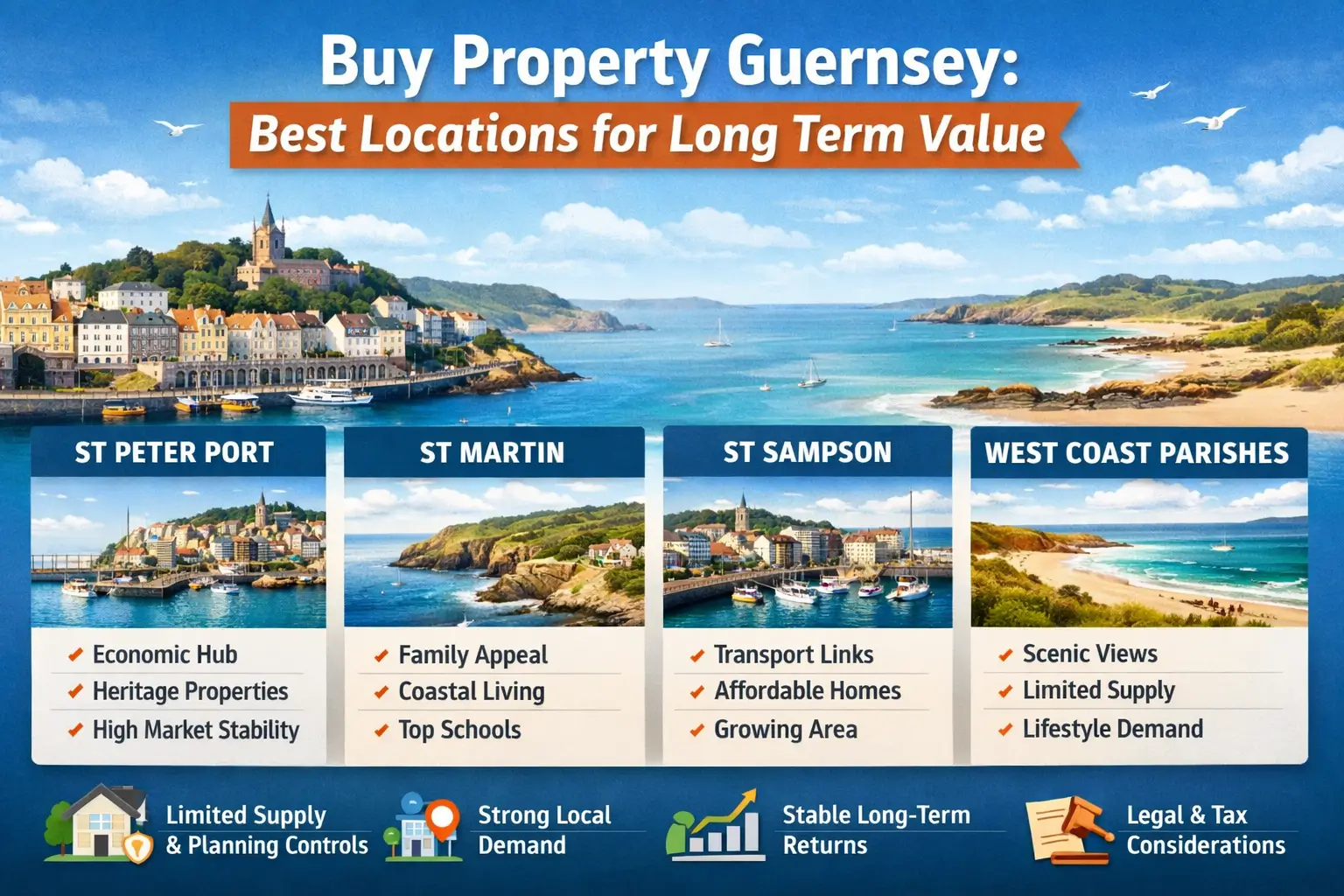
Buying property in Guernsey for long-term value typically means focusing on parishes with constrained supply, strong local demand, resilient employment drivers, and consistent lifestyle appeal rather than short-term price cycles. Locations such as St Peter Port, St Martin, St Sampson, and parts of the west coast have historically demonstrated better value retention due to infrastructure access, planning controls, and buyer depth.
Guernsey Property Market Context
Guernsey’s property market operates under a fundamentally different structure from mainland UK markets, and understanding this context is essential before assessing location-based value. The island has a fixed land mass, strict planning controls, and a population cap enforced through housing and residency regulations. These factors create structural scarcity, which underpins long-term property values across most segments.
Unlike speculative markets driven by rapid development, Guernsey’s housing supply increases slowly and predictably. New builds are limited by zoning rules, infrastructure capacity, and environmental protections. As a result, price movements tend to be less volatile over long holding periods, with value supported by limited supply rather than rapid demand surges.
Demand is anchored by local owner-occupiers, finance-sector professionals, retirees, and long-term residents rather than short-term investors. This buyer mix contributes to market stability and reduces the risk of sharp corrections tied to external economic shocks.
What Drives Long-Term Property Value in Guernsey
Long-term property value in Guernsey is primarily driven by location-specific fundamentals rather than speculative growth factors. Buyers assessing durability of value should prioritise parishes and neighbourhoods that consistently meet everyday living needs while remaining resilient to policy or economic change.
The most reliable drivers include proximity to employment hubs, access to schools and healthcare, transport connectivity, and planning protection that limits future overdevelopment. Properties in areas with established infrastructure and mature neighbourhoods tend to outperform newer or peripheral developments over extended timeframes.
Environmental and lifestyle factors also play a measurable role. Coastal outlooks, walkability, and access to amenities influence buyer demand across market cycles. However, these benefits must be weighed against exposure risks such as coastal erosion constraints or conservation-area restrictions that may affect future alterations.
Importantly, Guernsey’s tax and residency framework supports long-term residency rather than transient occupation. This encourages owner-occupancy and discourages rapid turnover, reinforcing price stability in well-located residential areas.
St Peter Port: Core Market Stability
St Peter Port is widely regarded as Guernsey’s most stable location for long-term property value due to its role as the island’s commercial, administrative, and transport centre. Property demand here is consistently supported by employment concentration, port access, and proximity to essential services.
The parish offers a diverse housing stock, including period townhouses, modern apartments, and converted historic buildings. This diversity attracts a broad buyer base, from professionals and downsizers to long-term investors, which helps maintain liquidity even during slower market periods.
Value resilience in St Peter Port is reinforced by limited redevelopment opportunities. Much of the town is subject to heritage and conservation controls, restricting large-scale new supply. While this can limit renovation flexibility, it also protects the character and scarcity that underpin long-term price retention.
For buyers focused on long-term holding rather than short-term appreciation, central and elevated areas of St Peter Port tend to perform better due to views, walk ability, and reduced exposure to transient rental demand fluctuations.
St Martin: Family Demand and Coastal Value Retention
St Martin consistently ranks among the strongest parishes in Guernsey for long-term value due to sustained family demand, school catchment strength, and limited land availability. Buyers prioritise this area for permanent residence rather than short-term occupancy, which supports price resilience across market cycles.
The parish benefits from a balance of rural character and coastal access, with proximity to cliff paths and beaches increasing lifestyle appeal without the congestion associated with central locations. Properties here are often held for longer periods, reducing transactional volatility.
Planning controls in St Martin restrict high-density development, preserving neighbourhood character and limiting supply expansion. This structural constraint has historically supported steady capital retention rather than rapid appreciation, making it attractive for long-term owner-occupiers and cautious investors.
St Sampson: Infrastructure-Led Market Resilience
St Sampson offers a different long-term value profile, driven by infrastructure access, employment proximity, and transport connectivity. As one of the island’s most commercially active parishes, it attracts buyers seeking practicality and affordability relative to St Peter Port.
Housing stock in St Sampson includes a higher proportion of modern estates and purpose-built homes, appealing to first-time buyers and working households. This creates a reliable base of transactional demand, supporting liquidity even during slower market conditions.
While price ceilings are generally lower than in premium coastal parishes, value stability is reinforced by everyday demand drivers such as retail access, schooling, and commuting efficiency. For buyers focused on functional long-term ownership rather than prestige, St Sampson remains a resilient choice.
West Coast Parishes: Scarcity, Lifestyle, and Premium Retention
Guernsey’s west coast parishes, including St Pierre du Bois and St Saviour, are characterised by lower housing density, environmental protections, and strong lifestyle demand. These factors contribute to long-term value retention, particularly for well-positioned detached homes.
Properties in these areas appeal primarily to buyers seeking privacy, natural surroundings, and long-term residence. Transaction volumes are lower, but pricing tends to remain firm due to scarcity and limited comparable stock.
Buyers should account for practical considerations such as transport dependence and service proximity. While these locations command lifestyle premiums, long-term value is best preserved in homes with balanced accessibility rather than isolated plots.
Location-Based Price and Value Comparison
| Parish | Typical Buyer Profile | Supply Constraint Level | Long-Term Value Outlook |
|---|---|---|---|
| St Peter Port | Professionals, downsizers | High | Strong and stable |
| St Martin | Families, owner-occupiers | High | Consistent retention |
| St Sampson | First-time buyers, workers | Medium | Resilient, functional |
| West Coast Parishes | Lifestyle buyers | Very High | Premium but selective |
Legal and Financial Considerations by Location
Property purchases in Guernsey are governed by local conveyancing procedures, including court-based registration and location-specific planning regulations. Buyers must ensure that intended use aligns with zoning permissions, particularly in rural and coastal parishes.
Financing terms can vary based on property type and location, with lenders assessing resale liquidity and demand depth. Homes in established parishes with broad buyer appeal typically attract more favourable lending conditions.
Long-term owners should also consider maintenance obligations, especially for older properties or those in exposed coastal settings where upkeep costs can influence net value retention over time.
Common Buyer Mistakes When Buying in Guernsey
A frequent mistake is over-prioritising short-term price movements rather than structural value drivers such as supply restriction and demand depth. Locations with apparent affordability may underperform over long holding periods if buyer demand is narrow.
Buyers also underestimate the impact of planning constraints, assuming future extensions or redevelopment will be straightforward. In many parishes, these assumptions can materially affect long-term usability and value.
Finally, failing to align property choice with long-term lifestyle needs often leads to premature resale, exposing owners to transactional costs that erode capital retention.
Aligning Location With a Long-Term Investment Strategy
Long-term property value in Guernsey is best preserved when location choice aligns with the buyer’s holding strategy rather than short-term market conditions. Buyers planning extended ownership periods benefit most from parishes where demand is driven by permanent residents instead of cyclical rental or relocation activity.
Properties close to employment hubs, schools, and essential services are more likely to remain desirable regardless of economic shifts. This reduces reliance on favourable market timing when selling and improves resale predictability.
Investors with long horizons should also assess future-proofing factors such as transport resilience, demographic trends, and planning policy direction. Locations already operating near development capacity often retain value more effectively than areas reliant on future infrastructure expansion.
Long-Term Ownership Versus Rental-Led Purchases
Buying property in Guernsey for rental income requires a different location assessment from buying for owner occupation. Rental demand is strongest in parishes with employment density and transport access, particularly St Peter Port and St Sampson.
However, long-term capital preservation tends to be stronger in areas dominated by owner-occupiers, where turnover is lower and pricing is less influenced by short-term yield fluctuations. This distinction is critical for buyers weighing income against long-term value retention.
Properties purchased primarily for rental yield may face greater exposure to regulatory or taxation changes over time. Buyers should ensure that projected returns remain viable under conservative assumptions rather than relying on peak rental conditions.
Future Risks That Could Affect Long-Term Value
While Guernsey’s property market benefits from structural supply constraints, long-term value is not immune to risk. Buyers should consider policy changes affecting residency, housing licences, or taxation, as these can influence demand patterns across parishes.
Environmental considerations are also increasingly relevant. Coastal properties may face stricter planning oversight, maintenance costs, or insurance considerations that impact long-term ownership costs and resale appeal.
Finally, demographic shifts, including an ageing population, may gradually alter demand for certain property types and locations. Homes adaptable to changing household needs are generally better positioned to retain value over time.
Frequently Asked Questions
Which parish in Guernsey is best for long-term property value?
St Peter Port and St Martin are widely regarded as offering the strongest long-term value due to supply constraints, consistent demand, and access to employment and services.
Is buying property in Guernsey a safe long-term investment?
Guernsey property has historically demonstrated stability rather than rapid growth. Long-term value is supported by limited land supply and demand from permanent residents.
Do coastal properties in Guernsey hold value better?
Coastal properties can retain value well when access and maintenance are manageable, but exposure risks and planning restrictions must be carefully evaluated.
Is St Sampson suitable for long-term ownership?
St Sampson offers reliable long-term value for buyers prioritising affordability, infrastructure access, and everyday demand rather than prestige pricing.
How long should buyers plan to hold property in Guernsey?
Long-term value benefits are most evident over extended holding periods, typically ten years or more, allowing owners to absorb market cycles and transactional costs.
Key Takeaways
- Structural scarcity: Limited land and planning controls underpin long-term value across Guernsey.
- Location matters: Parishes with employment access and owner-occupier demand retain value more consistently.
- Lifestyle balance: Coastal and rural appeal supports pricing when matched with practical accessibility.
- Risk awareness: Policy, environmental, and demographic factors should inform long-term decisions.
References
- States of Guernsey – Planning and Land Use Policies
- Guernsey Housing Market Reports
- Channel Islands Property Market Analysis